
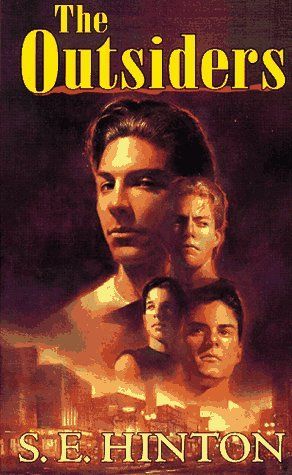
Issues Addressed: friendship, gangs, social discrimination, death
Disclaimer: This review contains spoilers!
“It seemed funny to me that the sunset she saw from her patio and the one I saw from the back steps was the same one. Maybe the two different worlds we lived in weren’t so different. We saw the same sunset.”-Ponyboy Curtis
This book. Where do I start with this book? Maybe by mentioning that it was written by a seventeen year-old girl? That was what made it all the more attractive to me, that a girl my age could create a brotherhood of boys so broken yet full. Of love so wrongly missing in places yet existing in abundance in others. Although a much lighter read compared to All the Bright Places, very heavy issues are still addressed. While reading, all I could think about was how different yet similar that world is to mine. The Outsiders was published over half a century ago. That’s fifty-five years to be exact. Can you imagine? Fifty-five years, yet teenagers everywhere are still struggling to find their identity, to figure out who they are, to fight bullying and preset images. Ponyboy Curtis’s world is no different than mine, yet I haven’t experienced an ounce of what he had. I can only describe this as the magic of books, the power to make you live an infinite number of lives in a finite one.
Other than the seriously creative names, the brotherhood between the six gang members Sodapop, Dally, Two-Bit, Johnny, Steve and Darry is one of the most intricate and serene friendships I’ve read about. There’s such unconditional love brewing between these boys that it makes you question the legitimacy of bonds formed in your own life. Dally was a cold-hearted fox, hardened by the unaccepting society that encased him, and at the ripe age of seventeen, he had seen too much to have any faith in what good remained in the world. I find that so heartbreaking, that he had to hide all this compassion and soul because the widely accepted socialites, also known as Socs, made him that way. The Socs saw a gang member, a boy who smoked cigarettes and put on too much hair grease for his own good. The Socs saw a runaway, a homeless kid who robbed stores and carried around a gun.
But that wasn’t him.
Dally was the boy who risked his life to save Johnny, a sixteen year-old abused relentlessly by both parents, from a burning church. Dally is the one who threw himself into the arms of death because he couldn’t live without Johnny, whom he secretly loved like a brother. There are so many examples of preset images and strong relationships in such a short book that it scares me.
How about The Curtis brothers? Sodapop, Darry and Ponyboy? They’re all such contrasting forces, bound by blood and endless love, even after the death of their parents. There is nothing they wouldn’t do for each other, and I love that. I love that this was published fifty-five years ago, and yet there are so many lessons that we can still learn from it. This book taught me that love binds people as family more than blood does. These boys were a family, all six of them. It was so raw and pure and realistic, the struggles they all faced because they were at the bottom of the social ladder (Greasers). Everybody judged them because of what they didn’t have. Money. Cars. Parents. This encased each of the boys in caged cells, walls that prevented them from chasing their dreams, from pursuing an education beyond High School, from being a football star. They were labelled as misfits, and just because of how they looked. But this wrongdoing goes both ways. Ponyboy unfairly assumed all Socs had it easy because they were rich, when in reality, they were fighting for their parents’ attention, or screaming at the top of their lungs to be heard, to be punished, to be treated like a human. This all fell on deaf ears, per usual.
Fifty-five years, and yet humans are still judging people, for lesser things than social status. People are being judged because of the colour of their skin. Aren’t we supposed to evolve? Isn’t it human nature to learn from the mistakes of our past? Shouldn’t racism and discrimination be something of the past? So, why is this still an issue? Why can’t we accept people for who they are? If the Socs understood that the Greasers were more than just their personal punching bags, maybe Johnny wouldn’t have died and Dally would be alive, chasing good instead of trouble. Maybe Ponyboy could think about college instead of how to defend himself against Socs with a switchblade.
A lot of things could be different if only humans dropped this predetermined idea that people are only what you see or hear. That we are nothing more than a flat surface with no edges or sides or angles.
We couldn’t be more wrong.
Each person is three-dimensional; you can never see them fully if you’re standing in one place. You must move to see their different sides, you must take initiative to get to know them before you judge them on the one out of a billion sides you could see. This is what I learnt from The Outsiders, that we are three-dimensional, and that nothing is truly as it seems.
Thank you for reading! Please leave any ideas or comments below!


One thought on “The Outsiders by S.E. Hinton”